

A coffee flavor note is a sensory descriptor, an aroma or taste in the cup that resembles familiar foods, created by the bean’s chemistry and shaped by origin, processing, and roast. Nobody added blueberry syrup or caramel flavoring to get those words on the bag. Professionals name and compare these notes using the Specialty Coffee Association’s flavor wheel and the World Coffee Research Sensory Lexicon, and where a coffee comes from, how it was processed, and how dark it’s roasted all determine which notes actually show up in your cup.
TL;DR:
- Most coffees display only two to four dominant notes due to the chemical compounds present, so focus on identifying a few key descriptors rather than matching every flavor word.
- Origin, processing method, and roast level heavily influence flavor notes, with natural processing and light roasts highlighting fruity and floral attributes, while darker roasts emphasize caramel and smoky flavors.
- Flavor notes originate from specific chemical compounds in the beans, such as esters for fruitiness and the Maillard reaction for caramel and toasted qualities, not from added ingredients or flavoring oils.
- The flavor wheel is a tool for professional calibration and expectation-setting, not a strict scoring system, so multiple descriptors within the same flavor family are normal and acceptable.
- Freshness significantly impacts taste, with aromatic compounds fading within weeks, so proper storage and grinding just before brewing are essential for detecting the intended notes.
Table of Contents
- What Coffee Tasting Notes Actually Mean
- The Nine Flavor Categories, and What to Listen For
- How Origin, Processing, and Roast Shape What You Taste
- How to Taste Coffee and Identify Its Notes
- What Words Like “Blueberry” or “Caramel” Actually Mean
- How Brewing Method Changes What You Actually Taste
- Why Freshness Changes the Notes You Taste
- Why Smell Does Most of the Work
- Tasting Notes vs. Added Flavoring: Not the Same Thing
- Our Take on Reading a Bag’s Tasting Notes
- Try the Notes Yourself With Purelight Coffee
- Sources
- FAQ
What Coffee Tasting Notes Actually Mean
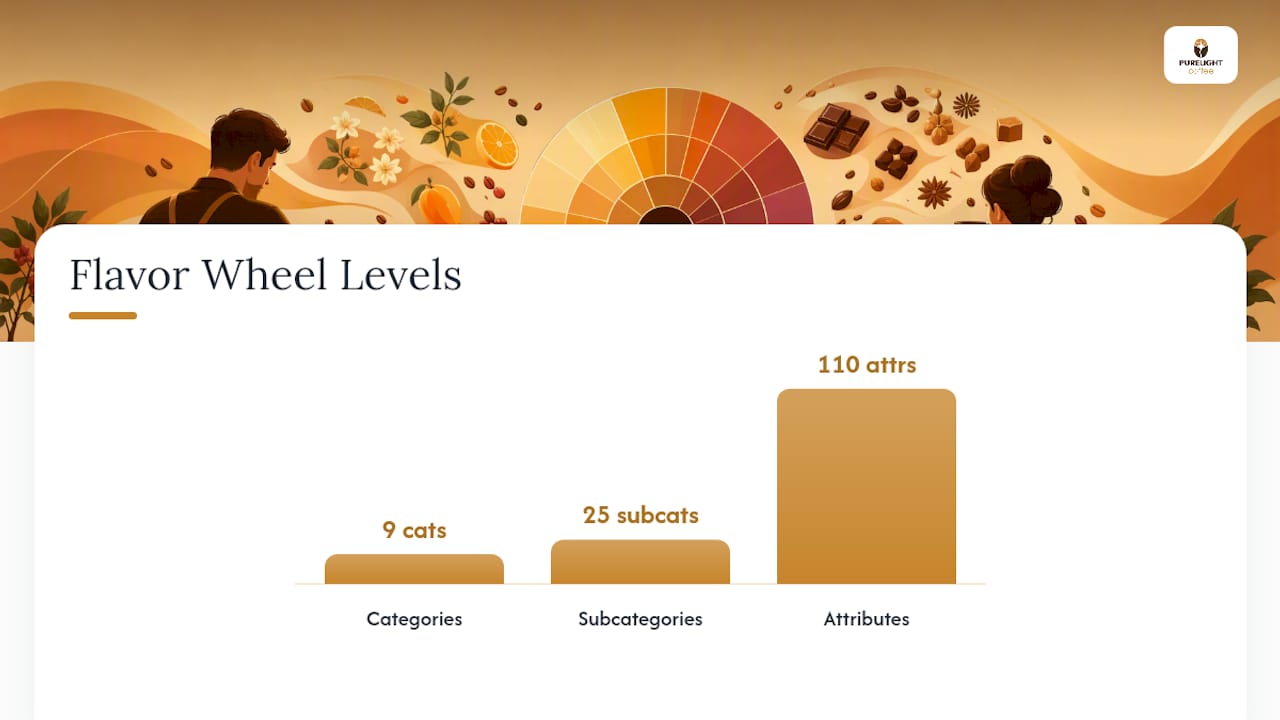
“Tasting notes” is the term you’ll see on bags and product pages, but the industry’s real reference point is the Coffee Taster’s Flavor Wheel, built by the Specialty Coffee Association in partnership with World Coffee Research. The wheel organizes flavor into a hierarchy: broad categories sit at the center, and as you move outward, the descriptors get more specific. Fruity sits in the middle ring; berry branches off it; blueberry sits at the outer tip. That structure isn’t decorative. It exists because the wheel and its companion reference, the World Coffee Research Sensory Lexicon, together define 110 distinct sensory attributes used to calibrate professional tasters against the same vocabulary.
The SCA’s own guide on using the wheel recommends starting broad and narrowing down. Taste the coffee, decide if you’re picking up something fruity, nutty, or sweet, then work outward until you land on a specific word. That center-to-edge method turns a vague impression like “something red” into a usable, repeatable descriptor, which is the whole point of building a shared tasting language in the first place.
You don’t need to buy anything to use these tools yourself:
- The official flavor wheel is downloadable from the Specialty Coffee Association.
- The full lexicon document is published by World Coffee Research and lists all 110 attributes with reference standards.
- Interactive versions, like the one from CoffeeTrove, break the wheel into three levels, roughly 9 categories, 25 subcategories, and dozens of specific notes, and let you click through them on a phone while you taste.
The Nine Flavor Categories, and What to Listen For
The flavor wheel groups every possible descriptor into nine primary categories. Most of them describe pleasant, desirable qualities. A couple exist specifically to flag defects.
- Fruity: berry, citrus, stone fruit, dried fruit. Look for this in natural-processed coffees and many East African origins.
- Floral: jasmine, rose, chamomile. Common in light-roasted Ethiopian coffees, where delicate aromatics survive the roast.
- Sweet: brown sugar, honey, vanilla, caramelized sugar. Almost every good coffee has some sweetness; it’s a sign of proper ripening and roasting.
- Nutty/Cocoa: almond, hazelnut, chocolate, cocoa. The signature profile of Brazilian and many Central American coffees.
- Spices: cinnamon, clove, pepper. Usually subtle, more common in darker roasts or aged coffees.
- Roasted: pipe tobacco, tobacco, burnt, smoky. Desirable in moderation on a dark roast, unpleasant if it dominates a light one.
- Green/Vegetative: grassy, hay-like, herbal. Fine in small amounts on underdeveloped light roasts; a strong dose usually means underripe cherries.
- Sour/Fermented: winey, fermented, sour. Winey can be a compliment in a natural-processed coffee; overt vinegar or fermented notes usually signal a processing flaw.
- Other (the defect category): papery, musty, chemical, medicinal. These almost always point to storage or handling problems, not desirable complexity.
Regional shorthand helps here too. Ethiopian coffees tend toward floral and berry notes. Brazilian coffees lean nutty and chocolatey. Kenyan coffees are known for bright, berry-forward acidity. None of that is a guarantee on any single bag, but it’s a reliable starting expectation.
How Origin, Processing, and Roast Shape What You Taste
Origin sets the baseline. Ethiopian coffees are known for floral and berry character, Brazilian coffees for nut and chocolate, and Kenyan coffees for a bright, almost berry-like acidity. Those patterns come from a combination of altitude, soil, and the specific coffee varieties grown in each region, and they’re consistent enough that they show up as shorthand across the entire industry.
Processing method changes the picture just as much:
- Washed coffees, where the fruit is removed before drying, taste cleaner and brighter, letting origin character come through with less interference.
- Natural processing, drying the whole cherry, concentrates sugars and fermentation byproducts, which is why natural-process coffees commonly show heavier berry and stone-fruit notes than washed lots from the same farm.
- Honey processed coffees sit in between, retaining some fruit mucilage during drying for added sweetness and body without going as far as a full natural. Purelight Coffee’s breakdown of honey processing covers why that middle step changes the cup.
Roast level then decides how much of that origin character survives. Lighter roasts preserve delicate volatiles like the floral compound linalool, while darker roasting drives Maillard and pyrolysis reactions that produce nutty, chocolate, and roast-derived flavors, per Roastopedia’s breakdown of how roast development changes the chemistry. A light roast keeps you closest to what the origin actually tastes like; a dark roast pushes the cup toward caramel, cocoa, and eventually smoke, regardless of where the beans came from. Brew method adds one more layer: pour-over tends to highlight clarity and acidity, immersion methods like French press build body and mute brightness, and cold brew mutes acidity further while amplifying sweetness and chocolate notes.
How to Taste Coffee and Identify Its Notes
You don’t need a cupping lab to do this well. A basic five-step routine, adapted from the same method used in professional coffee cupping, works fine at home:
- Grind fresh, right before brewing. Pre-ground coffee loses aromatic compounds fast.
- Smell the dry grounds first. This is often where the most distinct aromas show up.
- Brew, then smell the wet grounds and the crust that forms on top. Notes often shift once water hits the coffee.
- Sip and pay attention to acidity (does it taste bright or flat?), body (thin or syrupy?), and finish (what lingers after you swallow?).
- Try to name only 2 to 4 dominant notes. Hunting for every possible descriptor in one cup is a losing game.
Use the wheel the way it’s designed: start at the center category (fruity, nutty, sweet), then work outward toward the specific word once you’ve settled on the general family. Most specialty coffees genuinely show only 2 to 4 dominant notes, so if you’re struggling to name eight things at once, that’s not a skill problem. It’s just not how coffee usually presents.
Pro Tip: Train your sense memory before you even brew. The SCA’s own guide recommends smelling actual reference items, fresh blueberries, a jar of honey, a handful of walnuts, so your brain has a real anchor to compare against instead of guessing from memory.

Brewing two cups side by side, using a consistent brew ratio, and keeping a short notebook of what you tasted each time will sharpen your palate faster than any single tasting session can.
What Words Like “Blueberry” or “Caramel” Actually Mean
These descriptors aren’t poetic guesses. Roasted coffee contains more than 1,000 volatile chemical compounds, many of them the exact same molecules found in the foods the words describe. A note comes from real chemistry, aroma molecules and taste compounds that genuinely resemble something familiar, not a literal ingredient in the bag.
A few concrete links: fruity esters, produced during fermentation in natural processing, read as berry-like. The Maillard reaction, the same browning reaction that happens on seared meat or toasted bread, produces the compounds behind caramel and toasty notes during roasting.
Not every unfamiliar note is a good one, though. Watch for these defect signals:
- Papery or musty: usually poor storage or moisture damage before roasting.
- Phenolic or medicinal: often a processing or fermentation error at origin.
- Petroleum or chemical: almost always a storage or packaging problem, not a “flavor.”
How Brewing Method Changes What You Actually Taste
The bean doesn’t change between brew methods, but what reaches your cup does. A pour-over uses a paper filter and a relatively fast pour, which produces a cleaner, brighter cup that shows off acidity and delicate florals, since paper traps most of the oils and fine particles that would otherwise mute those top notes.
Immersion brewing, French press being the obvious example, works differently. The coffee sits in contact with water longer, and there’s no paper filter catching oils, so you get more body and a fuller mouthfeel, but sharper, brighter notes tend to get buried under that weight. A coffee that tastes bright and floral as a pour-over can taste noticeably heavier and more chocolatey brewed in a French press, even though it’s the same bag.
Cold brew changes things further. The long, cold extraction pulls out sweetness and body while pulling far less acidity than hot brewing does, which is why cold brew almost always tastes smoother and less bright than the same coffee brewed hot, even at a stronger concentration. Espresso, meanwhile, concentrates everything, intensifying sweetness, body, and any roast-derived bitterness at once, which is part of why the same beans can taste completely different pulled as a shot versus brewed as drip.
None of this means one method is “correct.” It means the brew method you pick is itself a decision about which notes you want to hear loudest, and it’s worth experimenting with the same bag across two or three methods before deciding you don’t like a coffee.
Why Freshness Changes the Notes You Taste
Coffee starts losing its most delicate aromatic compounds the moment it’s roasted. Volatile aromatics, the same molecules responsible for floral and bright fruit notes, are the first to fade, which is why a coffee that tasted vibrant and complex a week after roasting can taste flatter and more one-dimensional a month later, even though nothing about the roast level or origin changed.
Storage speeds up or slows down that decline. Air, light, heat, and moisture all accelerate the loss of those aromatics, so beans left in a clear container on a sunny counter fade faster than beans kept sealed in an opaque, airtight container in a cool cupboard. Whole bean coffee holds its character longer than pre-ground coffee, since grinding exposes far more surface area to oxygen right away.
The practical takeaway is simple: buy in quantities you’ll use within a few weeks, keep beans sealed and away from light, and grind only what you need right before brewing. A coffee’s flavor notes are a moving target, not a fixed property of the bag, and freshness is the biggest variable most home brewers overlook.
Why Smell Does Most of the Work
Most of what you register as “flavor” is actually aroma. Your tongue can only detect a handful of basic tastes, sweet, sour, bitter, salty, and umami. Everything more specific than that, blueberry, jasmine, caramel, walnut, gets identified through your olfactory system, either by sniffing the coffee directly or through retro-nasal olfaction, the aroma traveling up from the back of your throat while you sip.
That’s why smelling the dry grounds and the wet crust before you ever taste the coffee isn’t a ritual, it’s information. A lot of the most fragile, complex notes, particularly florals and bright fruit, show up more clearly in aroma than they do on the palate, where heavier tastes like bitterness can partially mask them. If you skip straight to sipping, you’re working with a fraction of the sensory data available.
This is also why a stuffy nose ruins your ability to taste coffee properly, and why professional cuppers spend as much time smelling as sipping. Aroma isn’t a preview of the flavor. For coffee, it’s most of the flavor.
Tasting Notes vs. Added Flavoring: Not the Same Thing
Tasting notes describe naturally occurring compounds already present in the roasted bean. Flavored coffee is a different product entirely: beans coated in artificial or natural flavoring oils, added after roasting, to create tastes like French vanilla or pumpkin spice that the coffee wouldn’t otherwise have.
A bag labeled with tasting notes like “blueberry, jasmine, brown sugar” hasn’t had anything added. Those words describe what trained tasters and everyday drinkers actually perceive from the bean’s own chemistry, the same volatile compounds discussed earlier in this guide. A bag labeled “vanilla flavored” or “hazelnut flavored,” by contrast, typically means flavoring was sprayed onto the beans after roasting, and that flavor will taste far more uniform and syrupy than a naturally occurring note ever does.
The confusion is understandable since both use food words. But naturally occurring blueberry notes in an Ethiopian natural-process coffee are subtle, shift depending on brew method and freshness, and coexist with other complex notes. Added blueberry flavoring tastes like blueberry candy, consistently, cup after cup, because it’s a manufactured additive doing exactly one job.
Our Take on Reading a Bag’s Tasting Notes
Tasting notes work best as an expectation-setting tool, not a test you’re failing if you can’t nail all four words on the bag. Tasting notes and roast level are listed on product pages to help people have some sense of what they’re buying before the coffee ships. That’s the entire purpose. It’s not about proving your palate is sophisticated enough to detect jasmine on the first sip.
What we’d push back on is treating the flavor wheel like a scorecard. The SCA and WCR built these tools to standardize professional cupping, not to make home coffee drinking feel like a pass or fail exam. If you taste “sweet and nutty” where the bag says “brown sugar and hazelnut,” you’re not wrong. You landed one ring closer to the center of the wheel than the person who wrote the label, and that’s a completely normal outcome. The words matter less than whether they help you find coffee you’d actually want to drink again.
— Shawn Lee
Try the Notes Yourself With Purelight Coffee
This brand offers product pages that list the roast level and tasting notes upfront, helping customers understand what they’re buying before the bag arrives. Want something familiar and crowd-pleasing? The Brazil Classic single origin delivers the chocolatey, nutty profile typical of Brazilian coffee, in a straightforward 12 oz bag. If you brew with a K-Cup-compatible machine and want balance without going too dark, Broken Top medium roast pods lean toward caramel and honey sweetness. Prefer bold and roast-forward? Flathead Valley dark roast pods show off the smoky, dark-chocolate notes that come from pushing roast development further.
U.S. orders ship with no extra shipping fee, facilitating trying multiple profiles side by side. Browse the full lineup on the single origin collection and pick a bag that matches the notes you actually want to taste.
Sources
- World Coffee Research | Sensory Lexicon
- Coffee Flavors: Roastopedia | The world’s coffee encyclopedia
- Coffee flavor wheel - Interactive SCA tasting guide | CoffeeTrove
FAQ
What Are Coffee Flavor Notes, Exactly?
Coffee flavor notes are descriptive words for the naturally occurring aromas and tastes already present in roasted beans, not added ingredients. Professionals identify them using the SCA flavor wheel and the WCR Sensory Lexicon, which defines 110 distinct sensory attributes.
How Many Flavor Notes Should I Expect in One Cup?
Most specialty coffees show only 2 to 4 dominant notes at a time, not a dozen. If you can name a couple of clear descriptors, you’re tasting the coffee correctly.
Is “Flavored Coffee” the Same as Coffee With Tasting Notes?
No. Tasting notes describe compounds already in the bean from origin, processing, and roasting. Flavored coffee has flavoring oils added after roasting to create tastes like vanilla or hazelnut that wouldn’t otherwise exist in that bean.
Does Roast Level Change the Flavor Notes?
Yes, significantly. Lighter roasts preserve delicate floral and fruity origin character, while darker roasts develop caramel, chocolate, and smoky notes through the Maillard reaction, as explained in Roastopedia’s roast breakdown.
Where Can I Find Coffees With Clearly Listed Tasting Notes?
Purelight Coffee lists tasting notes and roast level on every product page, including the Brazil Classic single origin and the Broken Top medium roast pods, so you can match a coffee to the notes you want before you buy.
Recommended
- Coffee Cupping Score: What Enthusiasts and Pros Should Know
- Coffee Brew Ratio: Practical Ratios and Recipes to Try
- Single Origin Espresso for Home Baristas: How to Dial In
This article was produced by the Purelight Coffee team. It’s general coffee and brewing information, not professional or medical advice - results will vary with your equipment, water, and beans.


