

If you want the real thing, look for the Bird Friendly seal on the bag along with a “100% Bird Friendly” claim linked here 100%, or cross-check the roaster against the Smithsonian’s own certified list before you buy.
TL;DR:
- The Bird Friendly certification requires farms to maintain at least 40% canopy cover, 10 native tree species, and a minimum canopy height of 12 meters, all verified by third-party inspectors.
- The certification is backed by over 4,000 farmers across 14 countries and supports a large-scale, sustainable agroforestry system that benefits bird habitats and soil health.
- Unlike vague “shade-grown” labels, Bird Friendly certification ensures full compliance with specific habitat and organic standards, preventing partial or false claims.
- Verifying a true Bird Friendly product takes seconds: look for the official seal, confirm full certification, organic status, and chain-of-custody, and check the roaster’s certification references.
- Incorporating Bird Friendly farming improves bird populations, soil retention, and pest control, with farmers potentially earning premium prices despite lower yields compared to sun-grown coffee.
Table of Contents
- What Bird Friendly Certification Actually Requires
- Bird Friendly vs. Shade Grown: Why the Terms Aren’t Interchangeable
- How to Verify a Bird Friendly Coffee Before You Buy
- Why Bird Friendly Farming Matters More Than a Label
- Where to Find Certified Bird Friendly Roasts
- Where Purelight Coffee Fits Into an Ethical Buying Decision
- An Editorial Take on Certification Fatigue
- Try Purelight Coffee Without Overpaying for Vague Labels
- Sources
- FAQ
What Bird Friendly Certification Actually Requires
The Smithsonian Migratory Bird Center built this standard around measurable forest conditions, not marketing language. A farm has to hit specific numbers before a single bag can carry the seal.
The norms document from the Smithsonian Migratory Bird Center lays out the agroforestry rules in detail:
- At least 40% canopy cover over the coffee plants
- A minimum of 10 different native tree species in that canopy
- A main canopy height of at least 12 meters
- Full organic certification as a prerequisite, not an add on
- Separate processing, storage, and labeling to keep certified lots from mixing with conventional beans
Beyond the tree math, the program runs at real scale. It supports more than 4,000 farmers across 14 countries, producing over 36 million pounds of coffee a year. That is not a boutique pilot program. It is a functioning agricultural system that happens to double as bird habitat.
Bird Friendly vs. Shade Grown: Why the Terms Aren’t Interchangeable
“Shade-grown” sounds like it should mean the same thing as Bird Friendly. It doesn’t, and that gap is where a lot of well-meaning shoppers get misled.
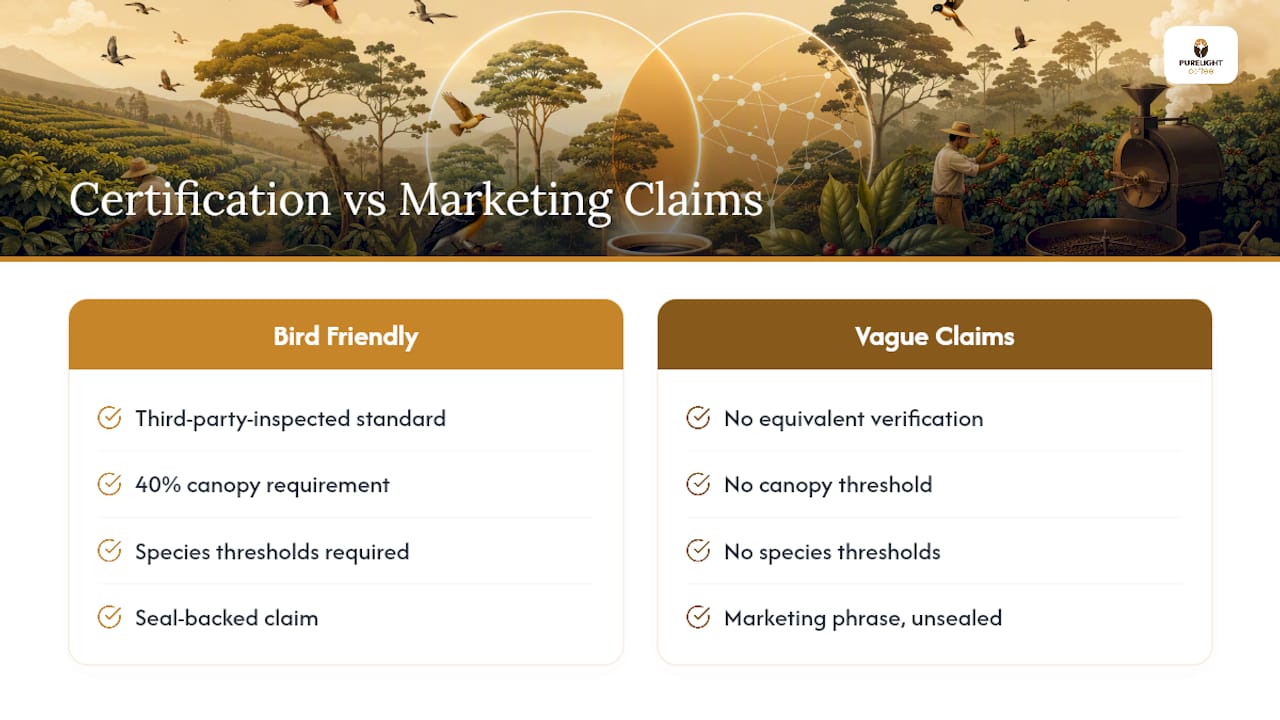
The word “shade-grown” has no legal definition and no enforcement body behind it. Nobody checks. Bird Friendly certification, by contrast, requires third-party verification against the specific canopy and species thresholds covered above.
Other sustainability labels run into a similar problem: many focus on labor conditions or price floors rather than habitat structure, and several allow partial compliance, meaning a bag can carry the seal even if only part of the coffee inside meets the standard. Bird Friendly doesn’t allow that blending.
- “Shade-grown” alone: no standard definition, no verification
- Bird Friendly: 100% of contents certified, third-party inspected, specific canopy metrics
- Other eco labels: often strong on social criteria, weaker on measurable habitat structure
Pro Tip: If a bag says “shade-grown” but doesn’t mention Bird Friendly, organic, or a specific certifying body, treat it as a marketing term, not a guarantee.
How to Verify a Bird Friendly Coffee Before You Buy
Checking a bag or a product page takes about thirty seconds once you know what to look for.
- Scan the packaging for the Smithsonian Bird Friendly® seal, not just the words “bird friendly” in lowercase marketing copy.
- Confirm the product states “100% Bird Friendly” or “100% certified,” since partial blends don’t qualify for the claim.
- Check for organic certification alongside it. Bird Friendly requires organic as a baseline, so a genuine claim will show both.
- Read the product page for mentions of separate lot processing or dedicated storage, which signals the roaster understands the chain-of-custody rules.
- If you’re still unsure, cross-reference the brand against the Smithsonian’s where to buy Bird Friendly coffee resource, which lists certified roasters directly.
- When in doubt, email the roaster and ask them to point you to their certificate number. A legitimate certified operation will have one on hand.
Why Bird Friendly Farming Matters More Than a Label
Shade farms function almost like a stand-in for the forest they replaced. Birds that need real canopy structure, understory cover, and species diversity find most of what they need on a well-managed Bird Friendly farm, in a way that sun-grown monoculture coffee simply can’t replicate.
Bird populations across the United States and Canada have dropped by nearly 30%, roughly 3 billion birds, since 1970, with habitat loss cited as a leading cause.
The same shaded structure that shelters birds also holds soil in place, sequesters carbon, and hosts natural pest predators, cutting a farm’s need for chemical intervention.
- Migratory and resident birds gain habitat that mimics natural forest structure
- Root systems and leaf litter reduce erosion and improve water retention
- Diverse canopy species support natural pest control, lowering input costs over time
- Farmers can earn premium pricing, though shade systems typically yield less coffee per acre than sun-grown plots, a real trade-off weighed against long-term soil and habitat resilience
Where to Find Certified Bird Friendly Roasts
The most reliable path is the Smithsonian’s own list. Their where to buy resource tracks certified roasters and gets updated as new ones join, which beats trying to verify a random bag at a grocery store shelf by sight.
Buying direct from a certified roaster’s website also gives you more to work with than a supermarket label. Product pages should spell out roast level, organic status, and the certification itself; if a page is vague on all three, that’s worth a second look before you check out.
- Start with the Smithsonian’s certified roaster list rather than searching blind
- Read product pages for explicit organic and Bird Friendly claims, not just “eco-friendly” language
- If your local grocery or café doesn’t carry certified options, the Smithsonian FAQ notes you can ask the manager to stock them, and they provide a template letter for exactly that
- Weigh roast level and price against availability. A certified medium roast you’ll actually drink every day beats a specialty single origin gathering dust because it doesn’t match your taste
Where Purelight Coffee Fits Into an Ethical Buying Decision
Purelight Coffee is an independent specialty coffee brand that ships across the United States, offering single-origin coffees, house blends, decaf, K-Cup compatible pods, instant coffee, and matcha. Coffee is roasted in small batches by our roasting partner in Bend, Oregon, and every product page lists tasting notes, roast level, and sourcing details so you’re not guessing at what’s in the bag.
We want to be direct about one thing: we’re not claiming Bird Friendly certification here. If that specific seal matters to your purchase, check the product page yourself, or reach out to our support team and ask directly. Compare what you find against the Smithsonian’s own canopy and organic criteria covered above rather than taking any brand’s word for it, ours included.
What we can offer is a straightforward way to try specialty coffee while you sort that out:
- Smith River (Medium House Blend) - 12 oz: an everyday medium roast for anyone who wants a dependable cup without overthinking it
- Brazil Classic (Single Origin) - 12 oz: a single-origin option for readers who want to taste one region’s profile clearly
- Mt. Siyeh (Instant Coffee) - 27 servings: a convenient format for travel or the office where a full brew setup isn’t practical
An Editorial Take on Certification Fatigue
Most consumer coffee content treats “shade-grown,” “sustainable” coffee, and “bird friendly” as roughly interchangeable, and that’s the core problem. It flattens a genuinely rigorous, third-party-inspected standard into the same bucket as a phrase a marketing team invented last quarter. The Smithsonian’s canopy and species thresholds exist precisely because vague language let too many farms claim credit for doing very little.
Where I think the conventional advice falls short is the assumption that a single purchase decision needs to solve everything at once, meaning certified, organic, direct trade, and low price. That’s an unrealistic bar for a weekly grocery run.
If you take one thing from this, let it be this: stop reading “eco-friendly” as a checkbox and start reading it as a claim that either has a seal behind it or doesn’t. Everything else is secondary.
— Shawn Lee
Try Purelight Coffee Without Overpaying for Vague Labels
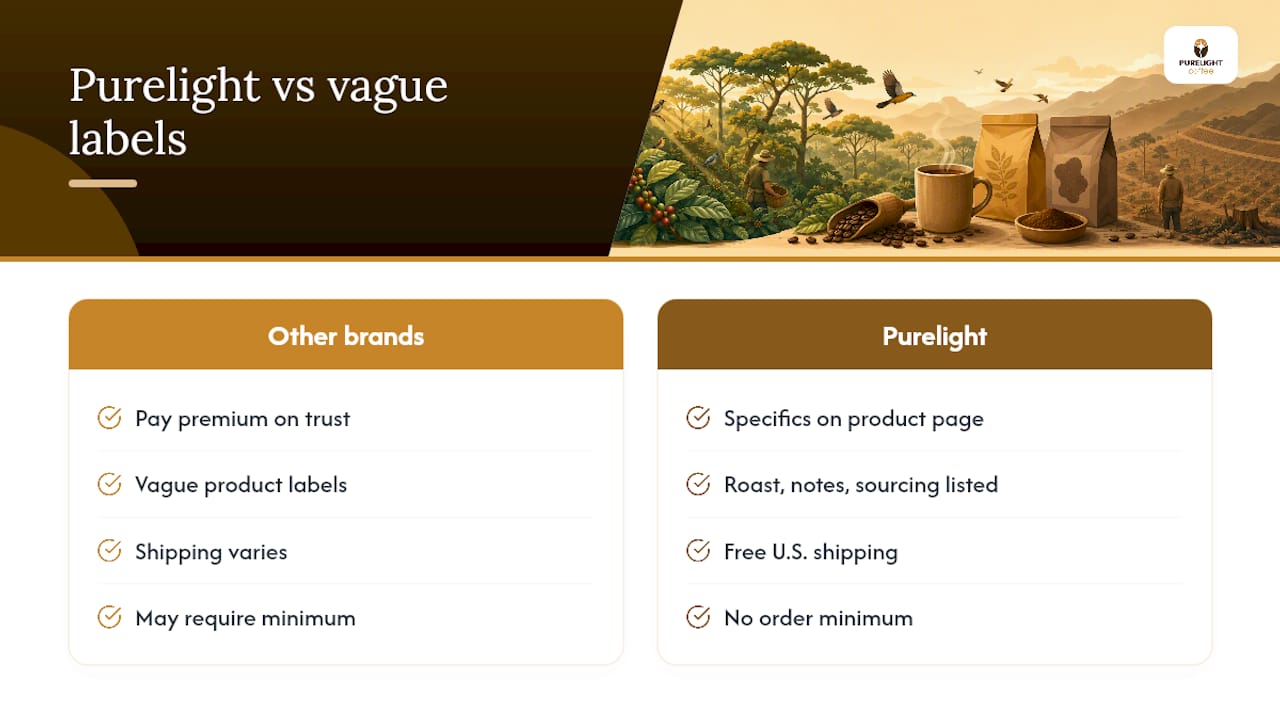
A lot of “sustainable” coffee marketing asks you to pay a premium on trust alone. Purelight Coffee skips that trade by putting the specifics on the product page instead, roast level, tasting notes, and sourcing detail, so you know what you’re buying before it ships. Every U.S. order gets free shipping with no minimum, whether you’re grabbing one bag of Smith River or a box of coffee pods.
Browse single-origin roasts, house blends, decaf, or matcha, pick what fits your morning routine, and start your first order today.
Sources
- Smithsonian Bird Friendly celebrates 25 years — Smithsonian Resilience Research
- Norms for Production, Processing and Marketing of Bird Friendly® Coffee (SMBC PDF)
FAQ
Is Starbucks Coffee Bird Friendly Certified?
Starbucks runs its own C.A.F.E. Practices sourcing program, which is not the same as Smithsonian Bird Friendly certification. If a specific claim matters to you, check the bag for the Smithsonian seal directly rather than assuming a large retailer’s general sustainability language covers it.
Is It Safe for Birds to Drink Coffee or Be Near Coffee Farms?
Birds don’t drink brewed coffee, but the concern behind this question is usually about pesticide exposure on conventional coffee farms. Bird Friendly’s organic requirement addresses that directly, since certified farms can’t use synthetic pesticides or fertilizers that would harm birds foraging in the canopy.
Which Bird Friendly Coffee Brands Are Sold at Whole Foods?
Availability changes by store and region, so the most reliable check is the Smithsonian’s own certified roaster list rather than assuming any specific retailer’s shelf. If your local Whole Foods doesn’t carry a certified option, the Smithsonian FAQ page provides a template letter you can hand to the store manager.
Is Peet’s Coffee Bird Friendly Certified?
Always check the individual product, not the brand as a whole.
Does Purelight Coffee Sell Bird Friendly Certified Coffee?
Purelight Coffee does not currently market any product as Smithsonian Bird Friendly certified. If that specific certification is a requirement for your purchase, check individual product pages or contact support directly before ordering.
Recommended
- Farm to Cup Coffee: What Traceability Really Means
- What Honey Processed Coffee Is and Why It Tastes That Way
- Light Roast Coffee: What It Is and Why Drinkers Choose It
This article was produced by the Purelight Coffee team. It’s general coffee and brewing information, not professional or medical advice - results will vary with your equipment, water, and beans.


