

Trace mycotoxins like ochratoxin A show up in a meaningful share of coffee samples worldwide, but typical brewed coffee exposure falls below the safety benchmarks set by the World Health Organization’s food safety group (JECFA) and the European Food Safety Authority. A systematic review of coffee products found ochratoxin A in about half of tested samples, yet estimated daily intake stayed under both agencies’ provisional tolerable daily intake figures. Prevention at the farm and mill level, plus standard roasting, keeps most coffee well inside that safety margin.
TL;DR:
- Mycotoxin contamination, especially ochratoxin A, is found in about half of coffee samples globally, but most levels stay below safety limits set by regulatory agencies.
- Roasting reduces OTA levels significantly, but it does not eliminate the toxin completely, and contamination often originates before roasting during harvest and drying.
- Coffee from regions with high humidity and improper drying practices is more prone to OTA contamination, emphasizing the importance of good postharvest handling.
- Regular coffee consumption generally results in OTA intake well below harmful thresholds, although instant and decaffeinated coffees may contain higher concentrations.
- Buying from roasters with transparent sourcing and third-party testing, along with proper storage, can reduce individual exposure risks.
Table of Contents
- What Are Mycotoxins and Which Ones Matter in Coffee
- How Common Are Mycotoxins in Coffee, Really?
- Health Risks and Regulatory Context
- How Mycotoxins Get Into Coffee: Supply-Chain Mechanics
- How Industry and Processing Reduce, but Don’t Eliminate, Risk
- Choosing, Storing, and Brewing Coffee to Minimize Exposure
- How Purelight Coffee Approaches Mycotoxin Risk
- Why Balanced, Evidence-Based Concern Actually Serves You Better
- Purelight Coffee’s Traceable, Small-Batch Options
- Sources
- FAQ
What Are Mycotoxins and Which Ones Matter in Coffee
Mycotoxins are toxic compounds produced by molds as a byproduct of their own metabolism. They form when fungi colonize a crop under the wrong conditions and they don’t necessarily disappear once the mold itself is dead. That’s the part people miss: killing the fungus doesn’t automatically neutralize what it already made.
In coffee, one mycotoxin dominates the conversation: ochratoxin A, usually shortened to OTA. It’s produced mainly by Aspergillus and Penicillium species, two mold genera that thrive in humid, poorly dried agricultural products. OTA is notably heat stable, meaning it survives temperatures that would kill the organism that made it. That single property explains almost everything about why coffee safety discussions center on OTA rather than on mold itself.
Aflatoxins get mentioned occasionally, mostly because they’re the most infamous mycotoxin family, tied to contamination in peanuts, corn, and tree nuts. They matter far less for coffee. Aflatoxin-producing molds prefer different conditions than the ones typical in coffee cherry drying and storage, so detection in coffee is rare and levels are usually negligible compared to OTA.
Roasting complicates the picture rather than solving it. Coffee beans hit temperatures between 400°F and 480°F during roasting, hot enough to destroy the living mold cells entirely. But OTA is a small, thermally resistant molecule, and destroying the fungus doesn’t guarantee destroying its toxin. Research on this point is genuinely mixed:
- Roasting reduces OTA levels, sometimes substantially, but the reduction ranges anywhere from roughly 58% to 96% depending on the study and roast profile.
- Lighter roasts sometimes retain more OTA than darker ones because of shorter time at peak temperature, though this isn’t a reliable rule for choosing a roast level based on safety.
- No published roasting method claims to eliminate OTA completely.
- The starting contamination level in green coffee still matters more than what happens in the roaster.
So the honest summary: roasting helps, it just isn’t a cleanup step you can count on to fix a badly stored batch of green coffee.
How Common Are Mycotoxins in Coffee, Really?
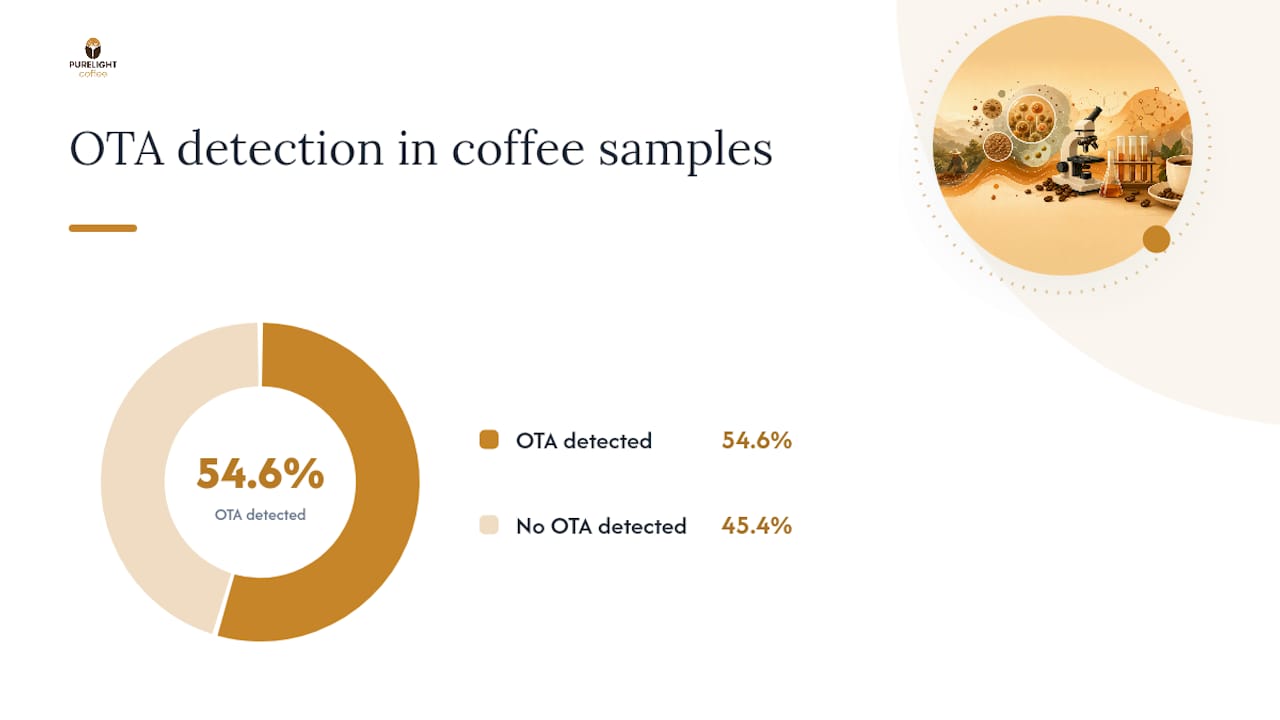
Detection isn’t the same as danger, and that distinction is where most alarmist coffee content goes wrong. The most comprehensive look at this question, a systematic review covering coffee studies from 1997 through 2024, found OTA in 54.6% of tested samples globally. That number sounds alarming until you look at the actual concentrations involved and compare them against regulatory thresholds.
The core finding: Even with OTA detected in over half of samples worldwide, estimated daily intake from drinking coffee came in below both the JECFA provisional tolerable daily intake (14 nanograms per kilogram of body weight per day) and the EFSA figure (17 ng/kg bw/day) for the large majority of consumers studied.
Concentration ranges vary by product type, and this is where it gets specific:
- Green (unroasted) coffee tends to show the widest range of contamination, since it hasn’t undergone any thermal reduction yet and reflects conditions at origin most directly.
- Roasted whole bean and ground coffee generally shows lower measured OTA than green coffee, consistent with the reduction effect of roasting.
- Instant coffee has repeatedly tested higher in some studies than roasted ground coffee. The extraction process used to make instant coffee concentrates soluble compounds from a large volume of brewed coffee into a small amount of powder, and OTA is water soluble enough to concentrate along with the flavor compounds.
- Decaffeinated coffee shows elevated readings in some surveys too, plausibly linked to the additional processing steps and handling time decaf beans go through before roasting.
- Brewed coffee, the actual beverage in your cup, reflects only a fraction of the dry bean’s OTA content, since not all of the toxin transfers into the liquid during extraction.
Origin-level research backs up why this variation exists. A study on coffee from Nayarit, Mexico isolated OTA-producing Aspergillus and Penicillium strains directly from both green and roasted samples, confirming contamination can originate well before a bean ever reaches a roaster and can persist through the process.
The reassuring part, and it’s a real finding rather than a talking point: only a minority of samples in the reviewed literature exceed European Commission maximum limits. Most coffee, most of the time, from most growing regions, tests well under regulatory ceilings. The exceptions cluster around specific handling failures rather than being evenly spread across the industry.
Health Risks and Regulatory Context
Ochratoxin A is classified by the International Agency for Research on Cancer as a Group 2B agent, meaning it’s “possibly carcinogenic to humans.” That’s a middle-tier classification, below confirmed human carcinogens, based mainly on animal studies and mechanistic evidence rather than confirmed human cancer causation. The primary toxicological concern is nephrotoxicity: OTA is best documented as a kidney toxin, and much of the regulatory framework around it exists specifically to protect kidney function in populations with regular dietary exposure.
Two safety benchmarks anchor the entire regulatory conversation:
- JECFA’s provisional tolerable daily intake (PTDI): 14 nanograms per kilogram of body weight per day.
- EFSA’s tolerable daily intake: 17 ng/kg bw/day, a slightly more permissive figure reflecting a different risk assessment methodology.
For a 154-pound adult (about 70 kg), the JECFA threshold works out to roughly 980 nanograms per day from all dietary sources combined, not just coffee. Coffee is one contributor among several, alongside grains, dried fruit, wine, and spices, all of which can carry OTA. The systematic review’s exposure estimates found that even regular coffee drinkers’ estimated intake from coffee alone stayed under these thresholds in the large majority of cases reviewed.
On the regulatory side, the European Union sets hard maximum limits: 3 micrograms per kilogram for roasted coffee and 5 µg/kg for soluble (instant) coffee. These numbers give inspectors and importers a clean pass/fail line.
The United States doesn’t have an equivalent. The FDA has not set a coffee-specific maximum limit for ochratoxin A, which means there’s no federal ceiling number to check U.S.-sold coffee against the way EU limits work for European coffee. That’s a real regulatory gap, not a safety verdict either way. It means American consumers who want assurance about mycotoxin levels are relying more heavily on voluntary industry testing and importer due diligence than on a government-enforced number.
How Mycotoxins Get Into Coffee: Supply-Chain Mechanics
OTA contamination isn’t random. It follows predictable failure points, all of which trace back to moisture and time.
- Harvest and initial handling. Overripe or damaged cherries, along with cherries that sit too long before processing, give fungi an early foothold. Physical damage and insect activity both create entry points for mold colonization that intact, promptly processed cherries don’t have.
- Drying. This is the single highest-risk stage. Fungi capable of producing OTA generally need a water activity (aw) above 0.80 to actively produce the toxin. Coffee dried slowly, unevenly, or in humid conditions can sit in that danger zone for days, giving Aspergillus and Penicillium strains time to establish and start producing OTA before the moisture finally drops low enough to stop them.
- Storage. Even properly dried coffee can pick up moisture again if stored in humid warehouses or without adequate ventilation. Rewetting after drying is one of the more common and preventable causes of late-stage contamination.
- Transport. Shipping coffee in containers without adequate moisture control, particularly on long ocean routes through humid climates, can push beans back into the fungal production range even after they left origin in good condition.
Origin climate shapes all of this. Regions with high humidity during harvest season, or growers without access to mechanical drying, face a structurally harder job keeping moisture in the safe range using sun-drying alone. This isn’t a knock on any particular growing region. It’s a reflection of how much labor and infrastructure OTA prevention actually requires, and why postharvest handling matters as much as the growing conditions themselves.
How Industry and Processing Reduce, but Don’t Eliminate, Risk
Processing method is the first real lever growers and mills have. Wet processing, where the cherry’s fruit is removed before drying, generally reduces contamination risk compared to natural (dry) processing, where the whole cherry dries with the fruit still on. Dry processing takes longer and keeps the bean in contact with sugars and moisture from the fruit for an extended period, which gives fungi more opportunity if drying isn’t managed carefully.
The industry-standard target is drying green coffee down to a moisture content below roughly 12% to 12.5% before storage and holding it there. That threshold isn’t arbitrary. It corresponds to the water activity level where OTA-producing fungi stop being metabolically active. FAO and International Coffee Organization guidelines built their entire code of practice around hitting and maintaining that number through drying, transport, and storage.
Roasting is the second lever, and it’s a genuinely useful one, just not a complete one. As covered earlier, published reduction rates run from about 58% up to 96% depending on roast profile and starting contamination level. That’s a wide range, and it means roasting is a risk reducer, not a guarantee. A heavily contaminated green coffee that gets an aggressive roast might still end up cleaner than a lightly contaminated green coffee that never goes through solid drying discipline in the first place. Starting material matters more than any single downstream step.
Industry codes of practice, including FAO/ICO frameworks, lay out a chain-wide approach:
- Sorting out visibly defective, insect-damaged, or discolored beans before drying and again before shipment.
- Drying to the target moisture threshold using consistent, monitored methods rather than guesswork.
- Avoiding rewetting during storage and transport through proper ventilation and packaging.
- Testing at key points in the chain, particularly before export and import, to catch contamination before it reaches a roaster.
Pro Tip: If you’re evaluating a roaster’s sourcing claims, look for language about drying practices and moisture targets at origin, not just roast date. Moisture control at the farm and mill level does more for mycotoxin prevention than anything that happens after the green coffee arrives at the roastery.
Choosing, Storing, and Brewing Coffee to Minimize Exposure
You can’t personally verify a coffee’s ochratoxin A level, but you can stack the odds in your favor with a few concrete habits.
Buy from roasters that are transparent about sourcing. A roaster that can tell you where a coffee came from and how it was processed is more likely to be buying from mills with decent drying discipline in the first place. That doesn’t mean farm-level or lot-level traceability guarantees a mycotoxin-free bag, but transparency correlates with quality-focused sourcing overall. Purelight Coffee’s sourcing pages walk through what traceability claims actually mean and what they don’t.
Look for third-party testing information, where a brand publishes it. Independent lab results on a specific batch tell you more than a marketing claim ever will.
Be modestly more cautious with instant and decaf coffee if mycotoxins are a real concern for you, given that both categories have tested higher in some surveys, likely tied to concentration effects in instant processing and extra handling steps in decaffeination. This is a preference adjustment, not a health mandate. Neither category is dangerous based on current data.
Store coffee properly once you get it home. For practical tips on cleaning and maintaining your car’s interior after accidental coffee spills, check out these helpful detailer tips.
- Keep beans or grounds in an airtight container, not the original bag clipped shut.
- Store in a cool, dry place, away from the stove or a sunny counter.
- Use coffee within a few weeks of opening for best flavor; this is mostly a quality issue rather than a meaningful mycotoxin risk, since OTA formation requires active fungal growth that shouldn’t be happening in a sealed container of dry roasted coffee at home.
Pro Tip: Brewing method (drip, pour-over, French press, espresso) has essentially no impact on mycotoxin exposure one way or the other. Choose your brew method for flavor and caffeine strength, not safety, and focus your actual safety attention upstream at the sourcing and storage stage.
How Purelight Coffee Approaches Mycotoxin Risk
Our coffee is roasted in small batches by a roasting partner in Oregon, a setup that keeps batch sizes manageable and roast profiles consistent rather than running large industrial-scale blends. Small-batch roasting doesn’t by itself certify mycotoxin levels, but it does mean fewer green coffee lots get combined into any single roast, which limits how far a contamination problem in one shipment could spread.
For readers who want to see actual testing information rather than take sourcing claims on faith, Purelight Coffee’s third-party testing page is the place to look. It’s worth understanding what lab testing does and doesn’t tell you:
- A test result confirms conditions for the specific batch or sample tested, not a permanent guarantee across every future shipment.
- Testing catches problems after the fact; it doesn’t replace good drying and storage practices at origin, which remain the actual prevention mechanism.
- Published test data gives you something concrete to evaluate instead of a vague quality claim.
Product pages list roast level, tasting notes, and origin details so you can make an informed choice, whether that’s a single-origin bean or a house blend, without overselling what any single data point proves.
Why Balanced, Evidence-Based Concern Actually Serves You Better
The data doesn’t support panic, and it doesn’t support dismissal either. OTA shows up in a lot of coffee at trace levels; that’s a fact worth knowing, not a reason to quit your morning cup. What I’d push back on is treating either extreme as the responsible position. Look for roasters who talk about sourcing and testing in specific terms, not just origin stories, and you’ll generally end up with better coffee regardless of the mycotoxin question.
— Shawn Lee
Purelight Coffee’s Traceable, Small-Batch Options
Purelight Coffee gives you a straightforward alternative to guessing about a grocery-shelf bag’s origin or handling history: transparent sourcing details on every product page, small-batch roasting, and no minimum order to try it. If you want a bright, well-defined cup with clear origin information, the Brazil Classic single origin is a straightforward starting point, smooth and balanced with the kind of consistency that comes from careful sourcing. Prefer something with more complexity and a sweeter finish? The Guatemala Gold single origin is worth a look, particularly if you already lean toward Central American coffees. If you’d rather not choose between origins at all, the Cascades medium-dark blend is built for a consistent, dependable daily cup. Every U.S. shopper, check the full coffee collection and the third-party testing page before you order to see exactly what’s behind the sourcing claims.
This article is general information, not a substitute for advice from a qualified doctor. Consult a qualified healthcare professional about your own circumstances before acting on anything here.
Sources
- A worldwide systematic review of ochratoxin A in various coffee products - human exposure and health risk assessment
- Determination of potentially mycotoxigenic fungi in coffee (Coffea arabica L.) from Nayarit
- Draft code of practice for the prevention of ochratoxin A contamination in coffee (FAO/ICO guidelines)
FAQ
What coffees have mycotoxins?
Ochratoxin A has been detected across green, roasted, instant, and decaffeinated coffee in studies worldwide, with instant and decaf sometimes showing higher readings than roasted whole bean or ground coffee.
How do you flush mycotoxins out of your body?
There’s no proven method to “flush” mycotoxins faster than the body’s normal metabolic processes; the more reliable strategy is limiting ongoing exposure through sourcing and storage choices rather than trying to detox after the fact.
What coffee has the least amount of mold or mycotoxin contamination?
No single product category is mold free, but coffee from roasters with strict moisture control at origin and available third-party testing, like the products detailed on Purelight Coffee’s testing page, tends to reflect lower and more consistent contamination levels than untraceable bulk coffee.
Is Starbucks coffee toxin free?
No major coffee brand, including large chains, can claim to be entirely free of trace mycotoxins, since detection is common industry-wide at low levels; what matters is whether measured levels stay under regulatory limits like the EU’s 3 µg/kg standard for roasted coffee.
Is ochratoxin A in coffee dangerous?
Typical exposure from drinking coffee falls below the JECFA and EFSA provisional tolerable daily intake benchmarks for most consumers, according to the systematic review of global coffee data, though OTA is classified as a possible carcinogen and kidney toxin at higher exposure levels.
Recommended
- Farm to Cup Coffee: What Traceability Really Means
- 5 Checks to Verify Ethically Sourced Coffee: Traceability, Price, Roas
This article was produced by the Purelight Coffee team. It’s general coffee and brewing information, not professional or medical advice - results will vary with your equipment, water, and beans.


