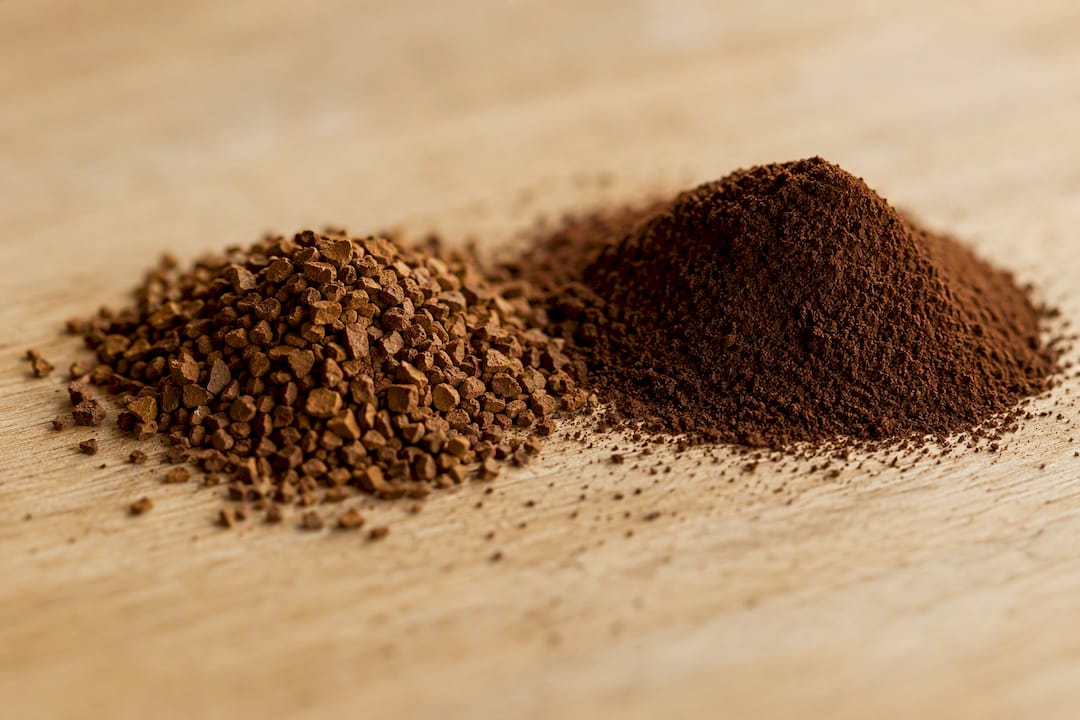
Freeze-dried instant coffee holds onto more of the original aroma and tastes closer to real brewed coffee. Spray-dried instant dissolves faster, costs less, and gives you a rounder, less sharp body. The clearest gap between them shows up in two places: how much aroma survives the drying process, and how the granules behave the moment hot or cold liquid hits them.
A 2024 lab analysis found freeze-dried coffee retained roughly 73–76% of volatile aroma compounds from the original concentrate, compared to about 45–50% for spray-dried coffee. That gap is the entire reason freeze-dried smells like coffee the second you crack the jar, while spray-dried needs milk or heat to show its best side.
- Aroma retention: Freeze-dried keeps roughly 25 to 30 percentage points more volatile compound content than spray-dried.
- Dissolution: Spray-dried powder dissolves almost instantly, even in cold liquid; freeze-dried granules dissolve well in hot water but lag behind in iced drinks.
- Bottom line: If you drink your coffee black and care about aroma, buy freeze-dried. If you’re making iced coffee, protein blends, or anything mixed with milk, spray-dried performs better and costs less.
Quick fact: Freeze-dried coffee retains about 73–76% of its volatile aroma compounds during drying, versus 45–50% for spray-dried coffee, according to a comparative lab study on both methods.
Key Takeaways
Freeze-dried coffee retains far more aroma than spray-dried, while spray-dried dissolves faster and costs less, so the right pick depends entirely on how you drink your coffee.
| Point | Details |
|---|---|
| Aroma retention gap | Freeze-dried retains about 73–76% of volatile aroma compounds versus 45–50% for spray-dried. |
| Dissolution behavior | Spray-dried dissolves faster in both hot and cold liquid due to its fine, uniform particle size. |
| Moisture threshold | Instant coffee starts clumping once equilibrium moisture reaches roughly 10% on a dry basis. |
| Cost driver | Freeze-drying’s longer batch cycles and higher energy use per kilogram explain its higher retail price. |
| Best product match | Purelightcoffee’s freeze-dried MT Siyeh Instant Coffee suits black-coffee drinkers seeking preserved aroma and roast-date transparency. |
Table of Contents
- What Is Freeze-Dried Coffee and How Is It Made?
- How Does Spray-Drying Turn Coffee Into Powder?
- Freeze-Dried vs Spray-Dried: Which Wins on Taste and Texture?
- How to Store Instant Coffee for Maximum Freshness
- Why Does Freeze-Dried Coffee Cost More Than Spray-Dried?
- Which Instant Coffee Should You Buy for Your Use Case?
- How Purelight Coffee Applies These Standards to Instant Coffee
- Try Purelight Coffee’s Freeze-Dried Instant for Yourself
- Sources
What Is Freeze-Dried Coffee and How Is It Made?
Freeze-drying coffee is a cold, slow process built around one goal: keep the aroma molecules that heat destroys. It starts with a strong brewed concentrate, not whole beans, and ends with the crunchy, irregular granules you probably picture when someone says “instant coffee.”
Here’s the sequence:
- Brew a concentrate. Coffee is brewed at a higher strength than a normal cup, then filtered to remove grounds.
- Freeze it solid. The concentrate is spread into thin layers or blocks and frozen, usually well below 0°F.
- Vacuum sublimation. The frozen coffee goes into a vacuum chamber, where pressure drops low enough that ice turns directly into vapor without passing through a liquid state. This step, called sublimation, is what separates freeze-drying from every other dehydration method.
- Break and package. What’s left is a dry, porous cake that gets broken into the crystalline granules sold on shelves.
The reason this matters for flavor comes down to temperature. Sublimation happens at low heat, so the fragile aromatic oils and compounds that give coffee its complexity never get cooked off. Spray-drying coffee, by contrast, blasts hot air at the extract, and heat is exactly what volatile aromatics can’t survive. Freeze-drying also does a better job protecting some antioxidant compounds, since prolonged heat exposure degrades those too.
The process is a batch operation, not a continuous line. Each freezer load has to freeze, sublimate, and dry before the next batch starts, which takes hours longer than spray-drying and is a major reason freeze-dried instant coffee usually costs more at retail.
You can spot freeze-dried coffee before you even open the jar. The granules are angular, slightly translucent, and irregular in shape, almost like small pieces of amber. Drop them in hot water and you’ll notice the aroma bursts out almost immediately, a direct result of all those preserved volatile compounds finally getting released by heat and moisture.
How Does Spray-Drying Turn Coffee Into Powder?
Spray-drying coffee is built for speed. Instead of freezing anything, the process uses heat and air pressure to turn liquid coffee into powder in a matter of seconds, which is why it’s the standard method behind most mass-market instant coffee worldwide.
The mechanics work like this:
- Concentrate the extract. Brewed coffee is reduced to a thick, concentrated liquid, similar to the freeze-drying starting point.
- Atomize the extract. The concentrate gets forced through a nozzle at high pressure, breaking it into a fine mist of tiny droplets inside a drying chamber.
- Hot-air drying. Those droplets meet a stream of hot air, often exceeding 400°F at the point of contact, and the moisture flashes off almost instantly.
- Collect the powder. What falls out is a fine, uniform powder, collected continuously as more concentrate feeds through the nozzle.
That continuous nature is the whole appeal. Spray-drying dries droplets in seconds rather than hours, and the process runs nonstop rather than in discrete batches. That throughput advantage is why spray-dried coffee dominates the instant coffee aisle and shows up in three-in-one mixes, flavored lattes, and bulk foodservice packaging.
The tradeoff is aromatic loss. Hot air is efficient at removing water, but it’s just as efficient at cooking off the volatile compounds that carry coffee’s brighter, more delicate notes. What survives tends to be the heavier, more heat-stable flavor components, which is part of why spray-dried coffee often tastes flatter or more one-note straight out of the jar.
Manufacturers can tune the outcome by adjusting nozzle design, chamber temperature, and airflow speed. A finer atomization produces smaller, more uniform particles that dissolve faster but may lose slightly more aroma in the process. Coarser atomization can preserve a bit more flavor at the cost of texture consistency. This is also why spray-dried powders integrate so well into milk-based and functional drinks: the fine, uniform particle size that makes them dissolve fast in cold liquid is a direct engineering choice, not an accident.
Freeze-Dried vs Spray-Dried: Which Wins on Taste and Texture?
The freeze-dried vs spray-dried coffee debate really comes down to four measurable differences: aroma, taste, particle texture, and how fast each dissolves. None of them make one method universally “better.” They make each method better suited to a specific kind of drink.
Aroma retention is the biggest gap between the two. The lab figures are stark: freeze-dried coffee holds onto 73–76% of its volatile aroma compounds, while spray-dried retains only 45–50%. In practical terms, that’s the difference between opening a jar and getting an immediate hit of coffee aroma versus opening a jar and smelling mostly… jar. Volatile aroma compounds are what your nose picks up before the coffee even touches your tongue, and they account for a surprising amount of what we register as “flavor,” since taste and smell are deeply linked.
- Freeze-dried: aroma compounds largely intact, closer match to fresh-brewed smell.
- Spray-dried: roughly half the volatile compounds gone, milder scent profile.
Taste follows the same pattern but shows up differently on the palate. Freeze-dried coffee tends to carry brighter top notes, the fruity, floral, or acidic characteristics that specialty roasters work hard to develop in the bean. Spray-dried coffee tends to taste rounder and heavier on body, with the sharper edges smoothed out. Industry practitioners frame it less as “better or worse” and more as different sensory outcomes for different applications: freeze-dried for someone chasing the top-note complexity of a good single-origin, spray-dried for someone who wants a dependable, mellow cup that won’t clash with cream and sugar.
Particle texture explains a lot of what you feel in the cup. Freeze-dried granules are crystalline, angular, and relatively large, a byproduct of that frozen cake being broken apart after sublimation. Spray-dried powder is fine and almost talc-like, a direct result of atomization. That texture difference isn’t just cosmetic. Coarser freeze-dried granules take a bit longer to fully break down, while the fine spray-dried particles create a smoother, faster-blending liquid. Neither has more “grit” once dissolved. The difference is entirely in how quickly and evenly each gets there.

Dissolution speed is where spray-dried has a clear edge, especially in cold applications. Spray-dried powder dissolves almost instantly in hot water and holds up reasonably well in cold water too, because the fine particle size gives it more surface area to interact with liquid. Freeze-dried granules dissolve well in hot water but can be stubborn in iced coffee or cold brew concentrate, sometimes leaving small undissolved flecks if you don’t stir long enough. This is also why spray-dried powders tend to tolerate milk, creamer, and functional additives more gracefully: the smaller particles blend into an already complex liquid without clumping.
Here’s a quick way to think about the trade-off: freeze-dried is the espresso shot of instant coffee, concentrated in character and a little slower to work with. Spray-dried is the pour that mixes in wherever you need it.
How to Store Instant Coffee for Maximum Freshness
Moisture is the enemy of both drying methods, but it hits freeze-dried and spray-dried coffee a little differently, and the numbers explain why proper packaging matters more than most people assume.
Freeze-dried instant coffee typically starts with low moisture content in a small single-digit percentage range on a dry basis, while spray-dried coffee often runs slightly higher, with moisture content generally a few percentage points higher than freeze-dried. Both numbers sound tiny, but instant coffee is sensitive to even small moisture shifts. That agglomeration point is the real threshold to worry about, not the starting moisture number on a spec sheet.
Packaging is what stands between your coffee and that threshold. A few materials do the job well:
- Glass jars with a tight seal protect against moisture but only if the lid creates a real seal, not just a snug fit.
- Metallized barrier pouches block both light and moisture vapor, which is why a lot of professional-grade instant coffee ships in foil-lined bags rather than plain paper.
- Airtight canisters work for everyday kitchen storage, especially once the original packaging has been opened and resealed repeatedly.
Freeze-dried coffee is the more fragile of the two once a container is opened. Its aromatic compounds are volatile by nature, meaning they escape into the air fast, so every time you leave the jar open, you’re losing some of the exact aroma that made freeze-dried worth buying. Spray-dried coffee is comparatively more forgiving of humidity swings, part of why it holds up better in bulk dispensers and foodservice settings where the container gets opened dozens of times a day.
Pro Tip: Portion out a small amount of your freeze-dried coffee into a daily-use container and keep the main jar sealed and refrigerated or in a cool, dark cabinet. This limits how often the bulk supply gets exposed to air, which does more to preserve aroma than any single storage gadget.

Be careful with desiccant packets. They’re useful in bulk shipping containers, but tossing a random silica packet into your everyday jar can sometimes pull too much moisture from the coffee itself if it’s not sized correctly for the container. A well-sealed jar in a cool, dry cabinet does more reliable work than an improvised desiccant fix.
Why Does Freeze-Dried Coffee Cost More Than Spray-Dried?
The price gap between freeze-dried and spray-dried instant coffee isn’t marketing. It’s a direct reflection of how much more energy and time freeze-drying demands.
Freeze-drying is a batch process that can take many hours per cycle, running vacuum pumps and refrigeration systems the entire time. Spray-drying, by comparison, dries droplets in seconds and runs continuously, feeding concentrate through the system nonstop rather than waiting on discrete batches. That throughput difference alone explains a lot of the cost gap at checkout.
Energy use tells the same story from a different angle. Industrial-scale spray dryers are energy intensive, with most of that consumption concentrated in the drying chamber itself, yet freeze-drying still uses considerably more energy per kilogram of finished coffee because it depends on sustained refrigeration and vacuum pressure over a much longer processing window.
- Freeze-drying: batch process, longer cycle times, higher energy draw per kilogram, higher retail price.
- Spray-drying: continuous process, faster cycle times, lower energy draw per kilogram, lower retail price.
- Hybrid methods: spray-freeze-drying (SFD) is gaining research attention as a middle path, with some studies showing SFD retaining around 85% of chlorogenic acid, a key bioactive compound, while aiming for better throughput than pure freeze-drying.
For a producer worried about supply-chain resilience or climate-related disruptions to energy costs, spray-drying’s lower energy footprint and faster turnaround make it the more stable choice at scale. That’s a big part of why spray-dried coffee remains the backbone of mass-market instant coffee production, even as premium brands lean on freeze-drying to justify a higher shelf price.
Which Instant Coffee Should You Buy for Your Use Case?
The right choice between freeze-dried and spray-dried instant coffee depends less on which method sounds fancier and more on what you’re actually going to do with the cup.
If you drink your coffee black, or close to it, freeze-dried is the better match. The aroma retention and brighter top notes translate directly into a cup that tastes closer to a fresh pour-over, which matters most when there’s no milk or sugar to mask a flatter profile. Premium and specialty instant coffee lines lean almost universally toward freeze-drying for exactly this reason.
If you’re making iced coffee, a three-in-one mix, a protein shake with a coffee kick, or anything that needs to dissolve in cold liquid, spray-dried is the more practical pick. Its fine particle size gives it a real edge in cold-water solubility, and it blends into functional ingredients like collagen, protein powder, or flavored creamers without clumping the way coarser freeze-dried granules sometimes do.
A short checklist to run through before you buy:
- What temperature will you mix it in? Hot water favors either method; cold water favors spray-dried.
- Are you drinking it black or with additives? Black leans freeze-dried; milk, sugar, or flavorings lean spray-dried.
- How fast do you need it to dissolve? If speed matters more than aroma, spray-dried wins.
- Are you fortifying it with protein, collagen, or other powders? Spray-dried integrates more evenly into blended mixes.
- How often will the container get opened? Frequent access favors spray-dried’s better humidity tolerance; occasional access is fine for freeze-dried if you reseal carefully.
None of this makes one method the objectively superior choice. It makes the decision a matter of matching the drying method to the drink you’re actually going to make tomorrow morning.
How Purelight Coffee Applies These Standards to Instant Coffee
Getting instant coffee right isn’t just about picking the correct drying method. It’s about what happens before drying even starts, and that’s where sourcing and roast control make or break the final cup.
Purelightcoffee builds every product, including its instant coffee lineup, around a few core practices that directly affect how well aroma survives processing:
- Direct sourcing from growers means the beans going into any batch, instant or otherwise, are traceable back to origin, which matters because inconsistent green coffee quality is a hidden variable that no drying method can fix after the fact.
- Small-batch, in-house roasting gives tighter control over roast profiles than mass-production roasting allows, which means the concentrate that eventually gets dried starts from a more consistent flavor base.
- Third-party quality testing verifies purity and freshness claims rather than asking customers to take them on faith.
- Transparent roast dates printed on each product let buyers judge freshness for themselves instead of guessing at shelf age.
That transparency extends into packaging decisions too. Because moisture control is central to preserving both freeze-dried aromatics and spray-dried texture, the packaging a product ships in isn’t a minor detail. It’s the last line of defense between the drying process and your cup months later. A batch of coffee dried carefully and then packed in a container that lets in humidity has essentially wasted the earlier work.
Roast-date transparency and small-batch control matter most in instant coffee precisely because the drying process has already stripped away some of the plant’s natural resilience. What’s left needs protecting, not guessing about.
The through-line across sourcing, roasting, and packaging is consistency. A drying method can only preserve the aroma and flavor that existed in the concentrate before it ever hit the freezer or the atomizer.
A Quick Take From the Editor’s Desk
If you’re choosing between freeze-dried and spray-dried for the first time, don’t overthink the “better” question. Ask what you’re drinking tomorrow morning. Black coffee, no additions, deserves freeze-dried every time. The aroma difference is not subtle once you’ve tasted both side by side. But I’d push back on the idea that spray-dried is the compromise choice. For iced coffee, protein blends, or anything going into milk, it’s not a downgrade. It’s the correct engineering choice, full stop.
What people underestimate is packaging. A cheap freeze-dried product in a loose-sealing jar can lose more real-world flavor than a well-packaged spray-dried one. If you want both convenience and a cup that actually tastes like something, look past the drying method label and check how the product is sealed and dated.
— Shawn Lee
Try Purelight Coffee’s Freeze-Dried Instant for Yourself
Most instant coffee on grocery shelves is spray-dried for cost reasons, which is fine for a quick mixed drink but leaves black-coffee drinkers wanting more aroma and depth. Purelightcoffee’s MT Siyeh Instant Coffee is built around the freeze-dried approach this article recommends for anyone who drinks their coffee straight.
Each package delivers 27 servings, sourced through Purelightcoffee’s direct grower relationships and roasted in small batches before drying, with the roast date printed on the product so you know exactly how fresh it is. Because freeze-dried aromatics are the most volatile part of any instant coffee, the packaging is designed to limit air exposure between uses, protecting the exact aroma compounds this article’s lab figures show freeze-drying preserves so well. If you’ve been drinking spray-dried instant out of convenience but want a black-coffee cup that actually tastes like coffee, order MT Siyeh Instant Coffee and see the difference the drying method makes for yourself.
Sources
Comparative Evaluation of Volatile Aroma Compounds Content of Freeze-Dried and Spray-Dried Instant Coffees: https://li05.tci-thaijo.org/index.php/buuscij/article/view/423
Spray Dried Coffee: How Instant Coffee Powder Is Made: https://www.sinothermo.com/id/insights/spray-dried-coffee-instant-coffee-process/
Spray-freeze-drying: a novel process for drying of foods and bioproducts: https://linkinghub.elsevier.com/retrieve/pii/S2772275922000090
Instant coffee products and packaging systems characteristics: https://doi.org/10.25186/.v18i.2150
- Comparative Evaluation of Volatile Aroma Compounds Content of Freeze-Dried and Spray-Dried Instant Coffees | Burapha Science Journal
- Spray Dried Coffee: How Instant Coffee Powder Is Made | Sinothermo insights
- Spray-freeze-drying: a novel process for drying of foods and bioproducts (Elsevier/Trends in Food Science & Technology)
- Instant coffee products and packaging systems characteristics (journal DOI reference)