

“Ethically sourced” sounds reassuring, but it should lead to a clear explanation. Before choosing a coffee on that basis, ask what the seller can show about how it was grown, purchased, and traced through the supply chain.
You do not need to become a coffee importer to ask useful questions. Start with the five below and look for answers that refer to the actual coffee being sold.
1. What exactly is being claimed?
A sourcing claim might concern farmer pay, working conditions, environmental practices, or several of these. “Ethical” on its own does not tell you which one the seller means.
Ask for the specific practice behind the wording. If a seller says growers are paid more, more than what? If it says the coffee protects habitat, what practices or certification support that statement? Clear wording makes the claim possible to check.
Also notice what is being described. A commitment for a whole company may not be a record for an individual coffee or harvest.
2. How specific is the origin information?
Look for the country, region, cooperative, farm, or lot named for the product. Then ask whether the details apply to the coffee currently available.
A farm name can make a sourcing record easier to follow. It does not establish working conditions or farmer compensation by itself. Equally, the absence of an individual farm name does not prove poor practice; some coffees come from groups of producers.
A useful question is: “Which part of this coffee's journey can you trace, and what records connect that origin to the product?” The answer should make the scope clearer, even if some information is unavailable.
3. What does the payment information actually show?
If the seller makes a claim about farmer pay, look for the amount, the recipient, the transaction stage, and the harvest or period it covers. A price paid to an importer or exporter is not automatically the amount a grower received.
A higher retail price can reflect coffee quality, roasting, packaging, shipping, or other business costs. It does not, by itself, prove better compensation at the farm.
For your own budget, compare bag size and cost per ounce. To assess a farmer-pay claim, ask for the payment information that supports it. These are two separate comparisons.
4. Which program applies, and what does it cover?
Certification and verification programs have different requirements. Read the named program's explanation and check whether the claim applies to the particular product.
- Fairtrade International: its coffee program includes minimum-price arrangements and a premium for coffee sold on Fairtrade terms.
- Fair Trade Certified: Fair Trade USA's coffee guide explains its own program, including requirements related to trading and producer communities. This is a distinct program, so use the name and standard actually shown.
- Rainforest Alliance: its certification program addresses farmer livelihoods, human rights, environmental practices, and climate resilience.
A logo should connect to an identifiable program and product claim. A certification is useful information with a defined scope; it is not a guarantee that every possible sourcing question has been answered. Other sourcing records can also be informative when no certification is claimed.
5. Can the seller give a clear answer?
Send a specific question about something that matters to you. For example: “Does this product have the certification named on your site, and where can I check its current status?” Or: “Does the payment figure you publish refer to the producer or another part of the supply chain?”
An answer may include a document, a link, or an explanation that a record is unavailable. What matters is that it addresses the question without replacing it with an unrelated claim about freshness, flavor, or a laboratory result.
A roast date describes timing. A cupping score describes a sensory evaluation. A laboratory report describes the sample and tests covered by that report. None of these, on its own, establishes ethical sourcing.
What Purelight shares
Purelight's product pages publish origin, processing, roast, and tasting information supplied by our roastery partner. We do not claim a direct relationship with growers or publish verified farm-gate payment records.
Our Sourcing & Testing page explains the information available. For questions about a particular coffee or to request the available reports, email info@purelightcoffee.com with its name. We will explain what the records cover rather than treating origin details or test results as a sourcing certification.
Choose the coffee for its flavor, too
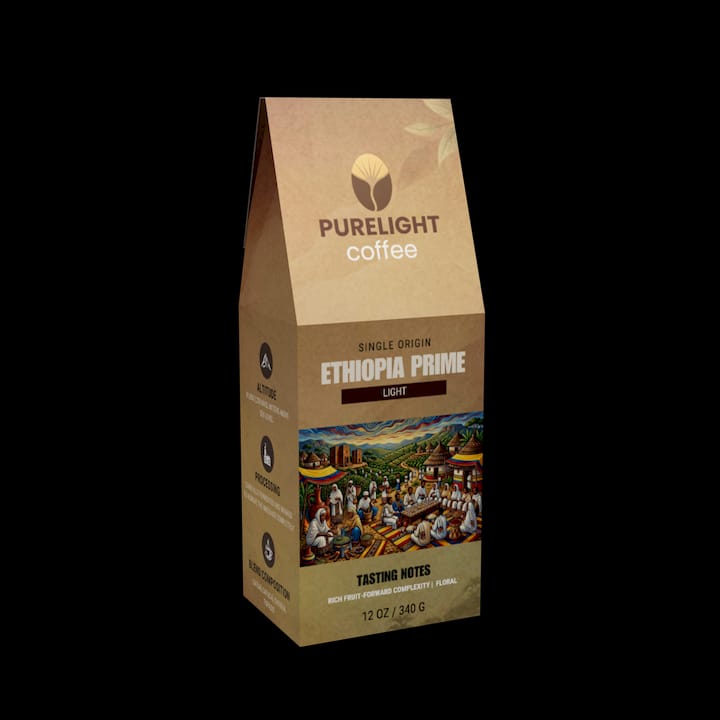
Ethiopia Prime is a natural-process coffee from Sidama with berry, stone-fruit, and floral notes. Those are reasons to consider it if you enjoy a fruit-led cup; they are not claims about farm-level pay or labor conditions.
For roasted-peanut and milk-chocolate notes, compare Brazil Classic. Read the sourcing information alongside the flavor description, and choose with a clear understanding of what each tells you.


