

Aim for water with mid-range minerals (roughly 150 mg/L total dissolved solids) and moderate alkalinity, and strip out chlorine before you touch anything else. If your tap water tastes clean, a carbon filter is enough. If it’s outside that range, mix distilled or reverse-osmosis water with a mineral packet or measured salts rather than guessing your way through bag after bag of beans.
TL;DR:
- Water with a total dissolved solids level around 150 mg/L and moderate alkalinity is ideal; too low or high levels negatively impact flavor and extraction.
- Alkalinity, especially bicarbonate, influences brightness and acidity; too much mutes vibrant notes, while too little can make coffee taste sharp or sour.
- Using bottled spring water or a properly filtered tap water is typically best; avoid high-mineral or sparkling waters that can cause bitterness or metallic flavors.
- Mineral adjustments, such as adding measured amounts of calcium and magnesium to distilled water, help fine-tune flavor and reduce scale buildup in equipment.
- Testing your water for chlorine, TDS, alkalinity, and hardness before treatment ensures effective adjustments and prevents unnecessary filtering or over-treatment.
Table of Contents
- What Water Chemistry Does to Coffee Flavor
- Coffee Water Temperature and the Numbers That Actually Matter
- Carbon Filters, Bottled Water, or Build Your Own
- How to Test Your Water Before You Treat It
- Scale, Machines, and Where Flavor Compromises Are Worth It
- Purelight Coffee’s Notes on Water and Flavor
- Comparing Bottled Water Options for Brewing
- Three Quick Tasting Tests to Hear the Difference
- Test the Difference With Coffees That Actually Show It
- Sources
- FAQ
What Water Chemistry Does to Coffee Flavor
Water isn’t a neutral carrier.
Alkalinity, specifically bicarbonate, is the biggest lever. It acts as a buffer against acidity, and alkalinity matters more than pH itself when it comes to how sour or bright a cup tastes. Two waters can have the same pH and taste completely different because one carries more bicarbonate. Push alkalinity too high and a bright Ethiopian natural tastes flat and muted, like someone turned down the volume on the acidity that made it interesting. Push it too low with no buffering at all, and the same coffee can taste sharp, sometimes almost sour, especially with darker roasts that lean toward bitterness.
Total dissolved solids (TDS) is the simpler number. It measures everything dissolved in the water, minerals included, and it correlates loosely with how much “grip” the water has on flavor compounds during extraction. Industry guidance from the Specialty Coffee Association points to a mid-range TDS target around 150 mg/L, with an acceptable window on either side. Water with almost no dissolved solids, like straight distilled water, extracts unevenly and tastes thin and flat because there’s nothing to help pull flavor compounds out of the grounds.
Calcium and magnesium do the heavy lifting inside that TDS number. Both participate directly in extraction, but they behave differently:
- Calcium tends to bond more with fats and can dull sweetness slightly while contributing to scale buildup in kettles and machines.
- Magnesium is generally the mineral coffee people prefer for flavor, since it seems to pull out more fruit and floral notes with less scale risk than calcium at equivalent hardness.
- Sodium, in small amounts, can round out perceived sweetness, but too much reads as flat or vaguely salty.
- Sulfate can sharpen acidity and clarity when present in moderate amounts, though high levels push toward a metallic or mine rally taste.
Here’s the quick sensory cheat sheet: too little mineral content and the coffee tastes thin, flat, or watery no matter how good the beans are. Too much alkalinity and it tastes muted, like the acidity got sanded off. Too much hardness and you get a chalky, sometimes bitter finish, plus a kettle that scales up twice as fast.
Coffee Water Temperature and the Numbers That Actually Matter
Chasing the “perfect” brewing temperature matters less than most people think. Research on brew temperature and sensory outcomes found that small temperature differences barely register when brew strength and extraction yield stay constant. Mineral content moves the needle more reliably than a degree or two of water temperature ever will. That said, 195 to 205°F remains the sensible working range for most brew methods, since going colder under-extracts and going hotter risks scorching delicate beans.
The numbers worth tracking are TDS, alkalinity, general hardness, pH, and chlorine. All of them get reported in mg/L, which is the same thing as parts per million (ppm), so don’t let a lab report with one unit and a filter box with the other confuse you.
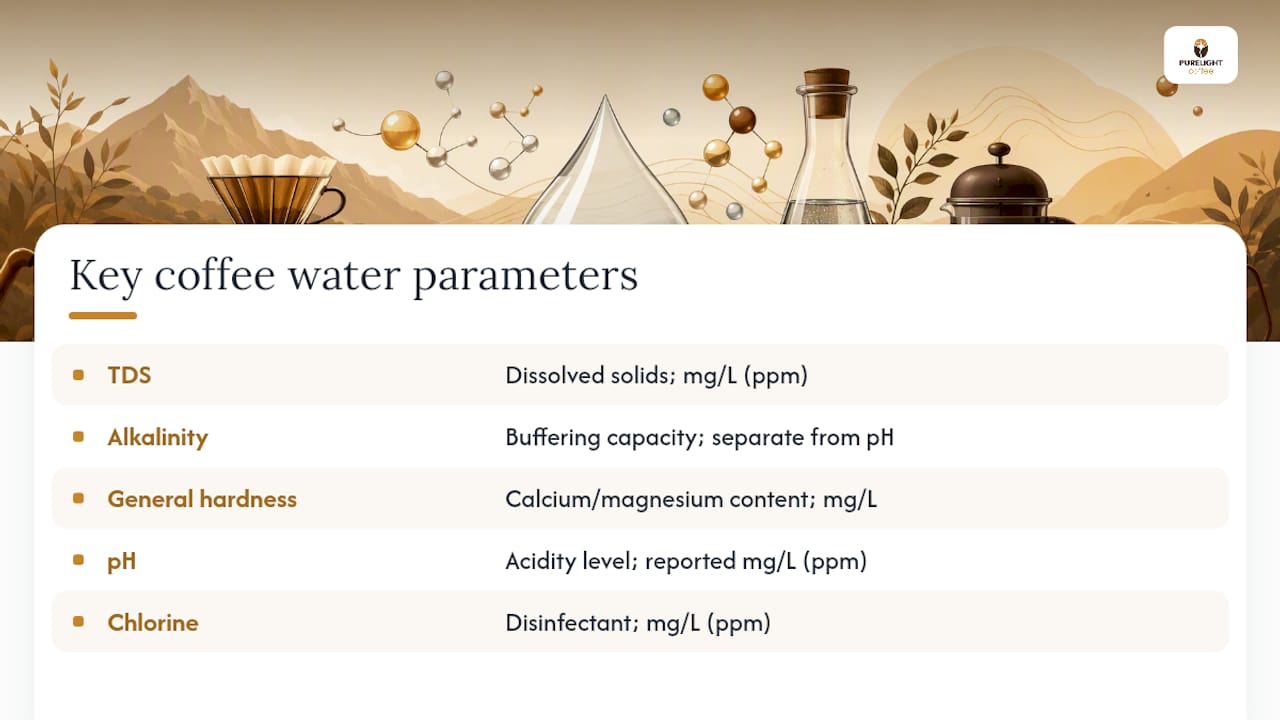
Municipal water-quality reports almost always list alkalinity separately from pH, and that distinction is where most people get confused. A water utility can report a pH of 7.2 (looks neutral, looks fine) while carrying alkalinity high enough to flatten every acidic coffee you brew. Read the alkalinity line specifically, not just the pH line.
For tools, a simple TDS meter (most run under $20) tells you dissolved solids in seconds and is genuinely useful for spot-checking filtered or bottled water; for more details on water-treatment solutions, visit Pure Wave Water. It won’t tell you alkalinity or hardness on its own, though. A home water test kit with titration strips covers alkalinity and hardness more directly, and for anyone serious about dialing in a permanent setup, a lab water analysis removes the guesswork entirely and gives exact figures for every parameter above.
Carbon Filters, Bottled Water, or Build Your Own
The right fix depends on how far your tap water sits from target, and how much effort you’re willing to spend getting there.
- Start with a carbon filter if your water is already close to the target range but tastes or smells like a swimming pool. A pitcher filter or inline carbon cartridge strips chlorine and chloramine, which cause a flat, chemical off-taste, without touching the mineral balance underneath. This is the cheapest fix and solves the most common complaint: “my coffee tastes like tap water.”
- Check bottled water labels if you travel, rent, or don’t want to deal with filtration at all. Look at the nutrition facts panel for TDS (sometimes listed as “total dissolved solids” or under mineral content) and skip anything heavy on sodium or labeled as sparkling or mineral water. Comparative label checks show a lot of bottled waters land in an acceptable range for brewing, but plenty don’t, so check before you buy a case.
- Go distilled or reverse-osmosis plus a mineral packet if your tap water is heavily out of range, whether that’s high alkalinity from well water or a municipal supply loaded with chlorine and hardness. Distilled water starts at zero minerals, which means you control every number in the final result.
For a homemade starting recipe, dissolve small, measured amounts of food-grade calcium chloride, magnesium sulfate (Epsom salt), and a pinch of baking soda into a gallon of distilled water. A basic starting ratio some home brewers use is roughly 1/8 teaspoon each of calcium chloride and magnesium sulfate per gallon, adjusted from there by taste. Commercial mineral packets follow the same logic, just pre-measured and standardized.
Pro Tip: Buy a cheap kitchen scale with 0.1 gram resolution before you start mixing your own recipe. Measuring salts by “pinch” or “eighth of a teaspoon” is how people end up with wildly inconsistent batches, and a $12 scale fixes that instantly.
How to Test Your Water Before You Treat It
Testing before treating saves money and prevents you from fixing a problem you don’t have. Work through this in order:
- Smell and taste it plain. If tap water smells like a pool or tastes metallic, that’s chlorine or pipe corrosion talking, and a carbon filter handles both.
- Run a TDS meter. Under 50 mg/L usually means your water is too soft and will extract thin, flat coffee. Over 300 mg/L usually means it’s too mineral heavy and will taste muddled or chalky.
- Pull your municipal water-quality report. Every U.S. water utility publishes one annually, and it lists alkalinity, hardness, and chlorine levels by name, not just pH. A quick search for your city plus “water quality report” usually finds it in minutes.
- Order a lab analysis if you’re building a permanent setup, running a machine with a boiler, or you’ve got well water with no public report to check. Lab testing costs more than a home kit but gives exact numbers instead of estimates, and it’s worth the money once, especially before installing any filtration system.
If your tap water lands inside the target ranges from the table above, you’re done. Filter for chlorine and move on. If it’s outside those ranges, treatment decisions belong in the section above, not in another round of guessing.
Scale, Machines, and Where Flavor Compromises Are Worth It
Hard, high-alkalinity water doesn’t just mute flavor. It builds scale inside kettles, espresso machine boilers, and drip machine heating elements, and that buildup shortens equipment life and eventually changes how evenly water flows through your grounds.
The Langelier Saturation Index is the technical tool water treatment professionals use to estimate scale risk at specific temperatures. You don’t need to run these calculations yourself as a home brewer, but knowing the concept exists helps explain why cafes with the same tap water as your house sometimes run completely different filtration setups. They’re optimizing for a $4,000 machine’s lifespan, not just flavor.
Practical mitigations for home brewers:
- Blend RO water with tap water rather than running straight RO, since a partial blend keeps enough hardness for flavor while cutting scale risk substantially.
- Flush and descale on a schedule, especially in hard-water regions, rather than waiting for visible buildup or a slowdown in flow rate.
- Accept a minor flavor trade-off if a full RO-plus-remineralization system is more money and maintenance than you want. Slightly harder water with a decent carbon filter beats an expensive system that gets ignored after month three.
Pro Tip: If you’re on well water with visibly hard buildup on faucets, get a hardness test before buying any filtration system. A whole-house softener solves scale but can push sodium high enough to flatten your coffee’s flavor, so a targeted under-sink RO unit for just your coffee and drinking water often makes more sense than treating the whole house.
Purelight Coffee’s Notes on Water and Flavor
Use these comparisons as starting points for your own tasting. Keep the coffee and recipe steady when changing water, then record what you notice.
- Lighter roasts and single-origin coffees show alkalinity changes the fastest. A light roast that tastes bright and citrusy with filtered water can taste noticeably duller with straight tap water carrying high alkalinity.
- Darker roasts and blends are more forgiving, since their flavor profile leans on body and roast character rather than acidity that alkalinity can wash out.
- Brew ratio and water chemistry interact. If you’re dialing in a new brew ratio, change one variable at a time. Adjusting water and ratio simultaneously makes it impossible to tell which change caused what.
- For espresso specifically, water can tolerate slightly higher alkalinity than filter brewing before acidity gets muted, since the concentrated extraction and added crema mask some of that flattening effect.
These are practical observations from working with our own coffee, not manufacturer claims about any specific water product.
— Shawn Lee
Comparing Bottled Water Options for Brewing
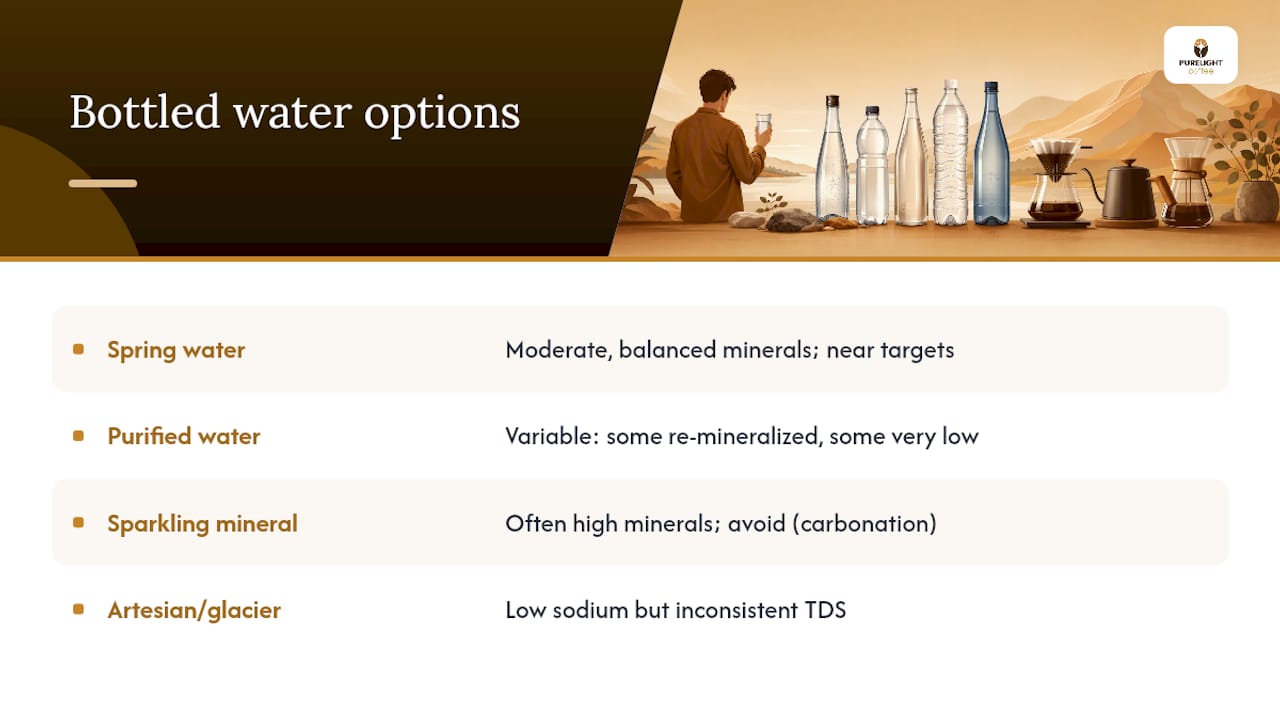
Not all bottled water is created equal for coffee, and the differences show up fast once you taste side by side. Spring waters generally carry moderate, balanced mineral content that lands close to brewing targets, which is why they’re a common go-to for home brewers without a filtration setup. Purified or “drinking water” labeled bottles vary more widely. Some brands run purification processes similar to reverse osmosis and then add back minerals, landing near the 150 mg/L sweet spot, while others strip minerals and add almost nothing back, producing the same flat, thin result as straight distilled water.
Sparkling and naturally carbonated mineral waters are worth avoiding for brewing. Beyond the obvious carbonation issue, many of these brands carry unusually high mineral loads, sometimes several times the recommended TDS range, which can push coffee toward a chalky or metallic finish. Artesian and glacier waters sit somewhere in the middle: often low in sodium, which is good, but inconsistent in overall TDS from brand to brand, so a label check still matters even within that category.
The most reliable approach with any bottled water is checking the nutrition facts panel for total dissolved solids or mineral content before buying a case for brewing. A bottle that tastes fine on its own doesn’t guarantee it will extract coffee well, since bottled water is formulated for drinking, not brewing.
Three Quick Tasting Tests to Hear the Difference
Run three cups back to back: one with carbon-filtered tap water, one with bottled water in the 100 to 200 mg/L range, and one with distilled water plus a mineral packet or homemade recipe. Keep dose, grind size, and temperature identical across all three, using the same brew ratio each time. Taste side by side, note which one tastes most balanced, and commit to that approach permanently. The differences are usually obvious within the first sip.
Test the Difference With Coffees That Actually Show It
For a simple comparison, use Mt. Siyeh instant coffee: measure 2g into 8 fl oz of each water and prepare both cups at the same temperature. A 54g tube makes 27 servings at that dose. To compare brewed coffee, use the same High Lakes recipe for both waters. If you prefer less caffeine, try Trapper Peak Decaf; decaf still contains some caffeine.
Try the carbon-filtered tap water pairing with Mt. Siyeh first, since it’s the fastest test. Move to the distilled-plus-mineral-packet approach with High Lakes if you want to hear acidity at its brightest. Browse the full coffee lineup and pick a bag to run your own water test against this week.
Sources
- Demystifying Water for Coffee — Scott Rao
- Water for Coffee: TDS, Minerals, and Why It Matters — Coffee Studies
- Brewing temperature and the sensory profile of brewed coffee — Nature Scientific Reports
FAQ
What kind of water is best for coffee?
Water with moderate total dissolved solids, around 150 mg/L, moderate alkalinity, and no chlorine works best for most coffee. Distilled water alone extracts flat and thin, while very hard or alkaline water mutes acidity and clarity.
How much coffee should I use for four cups of water?
A standard starting ratio is about 1 gram of coffee per water amount suited to brew strength, which works out to roughly 60 grams of coffee for four 6-ounce cups. Adjust from there based on taste, keeping the ratio consistent so you can isolate water changes from strength changes.
What is the best bottled water to pour over coffee?
Spring water with moderate, balanced mineral content usually performs best, since it tends to land closer to the 150 mg/L TDS target than heavily purified or sparkling water. Check the label for total dissolved solids before buying a case specifically for brewing.
How do I make my own coffee water?
Start with distilled or reverse-osmosis water, then add small measured amounts of calcium chloride and magnesium sulfate, roughly 1/8 teaspoon of each per gallon as a starting point, using a gram scale for accuracy. Taste and adjust from there, or use a premade mineral packet if you’d rather skip the mixing.
Does water temperature matter more than mineral content for coffee flavor?
No. Research comparing brew temperatures found that small differences barely register when extraction yield and strength are held constant, while mineral content and alkalinity produce much more noticeable flavor shifts.
Recommended
- Low-Acid Coffee and Sensitive Stomachs: What to Know
- Small-Batch Coffee: What Home Brewers Need to Know
- Single Origin Espresso for Home Baristas: How to Dial In
This article was produced by the Purelight Coffee team. It’s general coffee and brewing information, not professional or medical advice - results will vary with your equipment, water, and beans.


